
Here's something that still turns my stomach to remember. One year, near the end of a long wet spell, I opened the wardrobe to get a white coat — and it was still white, just a different sort of white: the whole shoulder line was furred with a fine, fuzzy bloom of mould, like it had snowed. Three things hanging in the same section were gone. The dry cleaner took one look and said, "Wet season, right? I see a lot of wardrobes like yours in old buildings."
The coat was saved, for a price. But what really made me get serious about damp was finding, later, a ring of black mould on the underside of my flipped mattress — the side I'd slept on every night for at least six months.
From then on, every wet season has been a war with humidity, and over time it settled into a fixed routine: what goes where, when to switch the machine on, how often to swap things out. This is the longest note on the site. I've written the whole routine down, from the principles to the shopping list, so you can get your kit and your head sorted in one afternoon and then live in peace through every wet season after.
The short version
- The first money you spend on damp isn't a dehumidifier — it's a cheap humidity meter. You can't manage what you can't see.
- There's one number to aim for: keep indoor relative humidity under 60%. Mould, dust mites and that musty smell all track it.
- Damp has six worst-hit spots: the wardrobe, under the mattress, cold outside walls, the bathroom, under the sink, and the corners by the balcony. Treat them one by one — don't just plonk a machine in the middle of the room.
- Size a dehumidifier up rather than down; running cost in a wet spell is small — far cheaper than a ruined coat.
- Wipe surface mould yourself; report rising damp to the landlord. They're two completely different responsibilities, and mixing them up costs you.
Why some homes mould so easily
First, know your enemy. For mould to grow, three things have to line up at once: humidity, warmth, and something organic to feed on. The trouble is that homes in warm, humid climates are practically built to provide all three.
Humidity. In warm humid regions, the year-round average relative humidity sits high, and in the wet seasons — a long rainy spell, or the warm-damp days when humid air meets walls that haven't warmed up yet — it climbs past 85%. Anyone who's lived through it knows the sight of a whole wall "sweating", water beading on the wall and the floor. And mould generally needs roughly 70% RH or more to bloom in earnest; dust mites have an even lower threshold, throwing a party from around 60%. In other words, in these climates the outdoor air is sitting in mould's comfort zone for much of the year.
Warmth. Most household moulds love 20–30°C, which is exactly the indoor temperature for much of the year in a warm climate. Too cold or too hot slows them down — but our long, mild spring and autumn are right in the sweet spot.
Organic matter. Dust, skin flakes, cotton and linen textiles, timber furniture, the emulsion paint on the walls — the whole room is a buffet.
Stack a renter's particular situation on top: older buildings often have poor ventilation, a sublet studio may have a single window onto a light well, a north-facing room never sees sun all winter, and ground-floor or top-floor flats catch ground moisture and roof leaks respectively. We can't change a building's constitution, but we can manage the humidity inside our own room — which is what this whole note is about.
See the enemy first: a humidity meter
Most people's first damp purchase is a dehumidifier. My advice is to first spend a few dollars on a small digital humidity meter (a hygrometer; basic ones are cheap, checked June 2026). The reason is simple: humidity is invisible, and you can't manage what you can't see. With a number in front of you, you'll know whether to switch the machine on now, when you can stop, and which corner of the home is the wettest.
A few details on using it:
- Remember one target band: 40–60%. That's the sweet spot where people are comfortable and mould and dust mites are not. In a wet season, getting under 60% is a pass — don't chase below 50%, which burns a lot of electricity and feels too dry.
- Where you put it matters more than having one. A meter in the middle of the room reads the average, but mould happens in the corners. My own setup is two: one lives in the wardrobe, one roams — taking turns patrolling under the bed, under the sink, the cold-wall corners. You'll be surprised the humidity inside and outside a wardrobe can differ by more than ten points.
- Watch it for a week and learn your home's "humidity routine". When does it spike on a rainy day? How long after a shower does the bathroom's damp spread into the room? How much does cooking a meal push the kitchen up? Once you know the patterns, your damp strategy moves from "by feel" to "by the numbers".
The whole-home damp map: six worst-hit spots
Damp isn't spread evenly; it picks the spots that don't breathe, that run cold, that sit near water. Look after these six and you've covered about nine-tenths of your mould risk.
1. The wardrobe (the side against an outside wall most of all)
A wardrobe is a sealed box stuffed with cotton-and-linen organic matter — a culture dish from the start. If the carcass backs onto an outside wall or a bathroom wall, the cold of that wall makes the inside of the cabinet condense, and the clothes on that side go first — my white coat was hanging against the outside wall. The full method is in section seven.
2. Under the mattress
All the moisture you give off in a night gets soaked up by the mattress; if the base is a closed ottoman or the mattress sits straight on the floor, the damp can't escape, and mould grows on the face you never see. The fix: stand the mattress up to air for half a day every fortnight; put a moisture absorber inside a closed ottoman base; if budget allows, switch to a slatted base so the mattress can breathe underneath.
3. North-facing walls and corners
A wall that never gets sun all year runs cold at the surface, warm damp air condenses on it, and over time black spotting grows in the paint. The fix: leave a 5 cm gap between furniture and that wall for air to move (wardrobes and headboards especially shouldn't sit flush); aim a fan at the corner now and then; and wipe down any condensation the day it appears.
4. The bathroom
The king of household humidity — it gets its own section, section eight.
5. Under the kitchen sink
Condensation on the pipes plus the odd small leak keeps the under-sink cupboard damp all year, and the spare pans and the cardboard of cleaning supplies stored in there go mouldy and rusty. The fix: line the cupboard with a moisture mat, put a calcium-chloride moisture absorber in, and raise things off the cupboard floor rather than letting them sit on it. If you smell mould, first check the pipe joints for a leak — if there is one, photograph it and report it to the landlord; that's a repair, not a cleaning job.
6. The balcony side and the patio-door track
Rain seeping through window gaps pools in the track, and the mould spots on the bottom of a curtain often start right there. The fix: check the track for standing water after a storm; shorten curtains so they clear the floor; and remember the balcony floor needs a clear drainage path (the lift-out access tile from the balcony note is a lifeline in the wet season).

Which home are you in? Five types
By the time you view a place, the type has already decided much of your humidity fate. If you're still flat-hunting, this section is a hazard map; if you're already in, pick out the points that match your type.
Top-floor / rooftop add-on
Hottest in summer, riskiest in rain. A thin or metal roof faces the sun and rain directly, and the classic disaster is water seeping into a ceiling corner after heavy rain. Key moves: photograph the four ceiling corners and around the window frames on day one (this is a priority area for your move-in evidence); after every storm or run of heavy rain, walk the ceiling, and the moment you see a water mark, photograph it and report it — roof waterproofing is the landlord's work, and leaving it until mould blooms makes both the responsibility and the damage harder to sort out.
Ground floor and semi-basement
Moisture creeps up from the ground: on the warm-damp days, the tiled floor films over with water. Key moves: raise all furniture off the floor (a set of plastic riser feet is cheap), keep cardboard off the ground, give the dehumidifier higher priority than in any other type, and put the mattress on a base with real height — sleeping straight on the floor here is sleeping on a sponge.
North-facing / light-well rooms
No sun all year, and the cold damp months are the disaster peak (plenty of people think only the rainy season needs damp-proofing — the cold, damp half of the year is sneakier). Key moves: keep a fan running, hold furniture 5 cm off the wall, and swap the wardrobe moisture absorbers twice as often as other types.
A studio with a windowless bathroom
The damp can't get out; it all rides on one extractor fan. Key moves: the extractor is your lifeline — if it slows down or gets noisy, report it to the landlord for replacement (a cheap part, and most landlords will deal with it); after a shower, close the bathroom door so the fan can do its job, rather than opening it and letting the damp into the room. This is the one most people get backwards.
Near a river, hill or coast
If you're near water or up against a hillside, your "baseline humidity" is naturally 5–10 points higher than other people's. Key moves: go up a size on dehumidifier capacity, seal valuables into boxes, and seriously consider moving the whole "wardrobe against the outside wall" to an inside wall instead — when you can't beat the damp head-on, get out of its way.
A dehumidifier: choosing, running and the cost
My first dehumidifier was bought through gritted teeth the year of the coat. Four hours after switching it on I went to empty the tank, and the moment I saw it half full of water I finally understood: I had been living in the same room as several litres of water a day. Ever since, it's been the home appliance I think a renter should most invest in, no contest.
Sizing it
A dehumidifier is rated by "litres of water removed per day". A rough rule of thumb is to scale capacity to floor area: a small studio is fine on a 6-litre-class machine, while a larger one-bed space wants a 10–12-litre model. Two principles:
- Size up rather than down. A bigger unit running on a low setting is quieter, lasts longer and uses less power than a small one flat out. If the budget allows, go up half a size.
- A damp-prone home gets more. Ground floor, top-floor add-on, north-facing, near water — push the sizing higher still.
Compressor or desiccant
The mainstream type is the compressor dehumidifier: strong extraction, relatively low running cost, ideal for warm and mild seasons; its weakness is that efficiency drops in cold conditions (below about 15°C). A desiccant model performs better in the cold and blows warm air, but uses noticeably more power — better suited to a cold, damp upland winter, or when you want to dry washing at the same time. For most people in a mild lowland climate, an energy-efficient compressor model is the right call.
What it actually costs to run
A typical energy-efficient compressor unit draws roughly 200–300 watts. Run it six to eight hours a day in a wet spell and you're using a couple of units of electricity a day — a small daily cost, a modest amount across a whole wet season. Set against a coat that costs real money to rescue, or a mouldy mattress you have to replace, this is the one expense in the whole note you shouldn't hesitate over. (Power prices vary by country — check your own tariff, but the order of magnitude holds.)
Five details on using it
- Close the windows. A dehumidifier works on the tank of air in the room; leave a window open and you're bailing while the tap runs.
- Stop by the humidity reading, not the clock. Under 60% and it can rest; most machines let you set a target, and 55–60% with auto start-stop is the least fuss.
- Aim it into the open wardrobe — wet-season first aid. Give the wardrobe a "sauna" once a week and the humidity inside halves.
- Rinse the filter every couple of weeks. A clogged filter drops efficiency faster than you'd think.
- Three safety don'ts: don't push it against the wall (leave 20 cm-plus front and back), don't cover it, and don't leave washing hanging right over it running unattended. Choose a model with tip-over auto-shutoff, and in an old building don't share an extension lead with high-wattage appliances.
The no-dehumidifier budget plan
In my student years, when a dehumidifier was out of reach, this combination got me through three wet seasons. It's not as good as a machine, of course, but done methodically it's enough to save your clothes and your mattress.
- Make "opening the window" a skill. Ventilating only dries things out when it's drier outside than in. Sealing up on a rainy day is the basic move; on a clear afternoon (usually the driest stretch of the day) open up and cross-ventilate for half an hour — worth more than leaving it open all day. Do this watching the humidity meter and you'll find your home's rhythm.
- A fan is worth its weight. Moisture hates moving air. Aim a fan at the corners, under the bed, the wardrobe in turn, set the dead air moving, and you roughly halve the chance of mould. A standard fan works too; a circulator's focused stream "drills" in better.
- Calcium-chloride moisture absorbers in small sealed spaces. A tub per wardrobe section, one in the shoe cupboard, one under the sink. They're a drop in the ocean in a big room, but genuinely useful in a single wardrobe section. Swap when the tub is over half full of liquid — about every three or four weeks in a wet spell (a pack of three is cheap, checked June 2026).
- Silica gel for precious small things. A camera, leather goods, important documents — store them in a sealed box with reusable silica gel packs, more reliable than any open method.
- Honestly: charcoal, coffee grounds and newspaper barely help. They absorb little and saturate fast. Fine for smell management; a liability as your main line.
Wardrobe and textiles: the white coat's revenge
After the coat, I worked the wardrobe into a standard routine, and never lost a garment again:
- Iron rule before storing: clean and bone dry. Clothes worn once carry skin oil and moisture back into the cupboard — a packed lunch for mould. Wash off-season clothes and dry them thoroughly (coats at least two days hung) before they go in.
- Don't cram it; leave air channels. A finger's width between hung clothes, folded stacks at 80% full. A wardrobe stuffed airtight can't be saved by any number of absorbers.
- Hang the cheap stuff on the outside-wall side. Whichever face backs onto an outside wall is the high-risk zone — hang quick-dry synthetics there, and move wool, leather and coats to the other side.
- An absorber tub per section, refilled monthly in the wet season. Leave a humidity meter in the cupboard too; over 65% is the signal to aim the dehumidifier at it.
- Off-season valuables into vacuum bags or sealed boxes with desiccant. Down and fur don't suit long-term vacuum compression — use a sealed box plus silica packs for those.
- Leather goods and shoes: air them a night after wearing before they go back in, with a desiccant pack inside the shoe. Mould on leather comes off with a soft cloth and a little leather cleaner, then a conditioning oil — the sooner you catch it, the more you save.
Rattan baskets, woven mats and natural-fibre matting are another group of high-risk residents: air them in the sun once before the wet season, keep them off the outside wall, and treat any mould spots with diluted alcohol on a cloth, then dry them thoroughly.
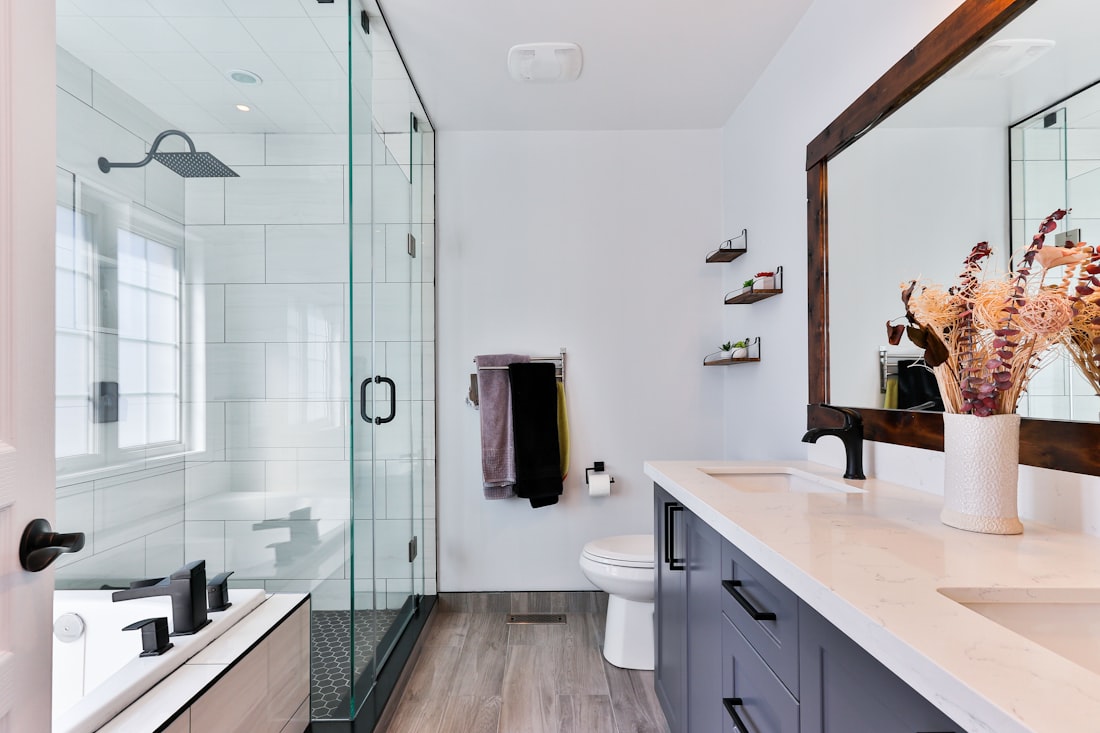
The bathroom: mould headquarters
The bathroom war runs on two fronts: daily defence and a periodic counter-attack.
Daily defence: two minutes a day
- Squeegee after a shower. A cheap squeegee, pushing the water off the walls and floor into the drain, cuts the bathroom's drying time from six hours to one. It's the best value of every anti-mould move there is.
- Leave the extractor running thirty minutes more. You leave after a shower; the fan stays behind on overtime. No extractor? Open the door and aim a fan in.
- No towels left in the bathroom. A wet towel hanging in there keeps humidifying the air. Hang it somewhere airy or on the balcony.
- Pull the shower curtain out to dry. A folded wet curtain is solid mould in the creases; pull it flat after use, and every couple of months put it through the machine (with a little bicarb).
Periodic counter-attack: silicone and grout
The black spotting on the silicone (the white sealant bead around the tub and basin) is the most stubborn enemy, because the roots run into the body of the sealant — wipe the surface and it resurfaces weeks later. What works is a thick application of mould-remover gel: squeeze the gel onto the spots and leave it six to eight hours (overnight is easiest), then scrub off with an old toothbrush and rinse. Most black spots clear in one go. Grout the same. A 1:10 diluted bleach poultice (kitchen paper soaked and laid on) also works, but open a window, wear gloves, and never mix it with any acidic cleaner.
If a whole run of silicone is too far gone to save, "cut it out and re-bead" is a small job — but it touches the building itself, so message the landlord first. Most will arrange it or agree to let you, and leaving a good "I maintain your place" impression is goodwill at the final inspection.
Condensation vs rising damp: who fixes what
Water on a wall comes from two sources, handled completely differently and with completely different responsibility. This section may be the most valuable in the whole note.
Surface condensation → you handle it
Symptoms: on a rainy or warm-damp day, the wall, window frame or tiles "sweat", and it wipes away clean; the mould that grows is surface black spotting, in the cold spots — corners and around windows. This is airborne water condensing on a cold surface, a use-side issue. The fix: wipe it dry the day it appears, lower the room humidity (everything in the four sections above), and treat surface spots with 70–75% alcohol or diluted bleach (mask and gloves, window open, test a small patch first); once dry, a mould-inhibiting spray helps keep it off.
Rising damp → photograph it, report it
Symptoms: the paint blisters, flakes, powders; there's a white crystalline powder to the touch; it spreads wider over time and grows back after you wipe it. This isn't a surface problem — it's water getting into the body of the wall (a crack in an outside wall, a leaking pipe, ageing roof waterproofing), carrying the salts out of the wall and bursting the paint. Water in the structure is a fault with the building itself, and structural damp is usually the landlord's repair (rules vary by country and state — check your local tenancy authority). Three things to do:
- Photograph it the day you find it (a wide shot, a close-up, and something for scale), message the landlord to report it, and keep a timestamped record — there's a template in section six of the deposit note.
- Move furniture away from that wall, to stop your own things soaking against a wet wall and going mouldy — and to cut yourself clear of any "you let it spread" argument.
- Don't buy waterproof paint and cover it over. You won't seal the source (the water's still in the wall), and at the inspection it muddies whether "you damaged this wall". By the same token, photograph any rising damp that's there on day one as part of your move-in photos.
Mould rescue by material
Prevention done — now the clean-up, since most people find this note after they've already seen mould. Different materials need completely different methods, and the wrong one turns a small problem into a big one. General prep for all of them: mask and gloves, window open, and don't aim a fan directly at it while you work (it blows the spores everywhere).
Walls (emulsion paint)
Surface black spots: press and wipe with 70–75% alcohol on kitchen paper (test a corner for colour first), then a mould-inhibiting spray once dry. Don't scrub back and forth — a brush pushes the spores deeper into the paint. Anything larger than A4, or that keeps coming back, go back to section nine and judge whether it's rising damp; if it is, report it.
Wooden furniture and timber floors
White powdery surface mould: a soft cloth with diluted alcohol, wiped along the grain, then a coat of furniture oil once dry. Black mould that's soaked in means water has got into the wood, and wiping only fades it — if it's the landlord's furniture, photograph and report it with the location noted (often the side against the wall, which conveniently proves it's the wall's problem); if it's your own, take the lesson and keep it 5 cm off the wall next time.
Fabric sofas, mattresses, rugs
Small patches: vacuum first (bin the bag straight after), mist with diluted alcohol, dry thoroughly, and put it in the sun on a fine day. Large areas or a smell that won't wash out: honestly, mould deep in the fibres is hard to kill, and if a mattress is mouldy over more than a hand's width I'd replace it — the thing you sleep on eight hours a night isn't worth sharing with mould. Prevention is always cheaper: stand the mattress up every fortnight, and use a waterproof protector in the wet season.
Leather goods, shoes, leather sofas
The sooner you catch it the cleaner the escape: a soft cloth with a little leather cleaner (or 1:1 diluted alcohol, colour-tested first), wiped, air-dried, then leather oil, and stored afterwards in an airy cupboard with a desiccant pack. Never put it out in strong sun — leather goes brittle and cracks; the mould survives, the leather doesn't.
Grout and silicone
The thick mould-gel application from section eight, with one order-of-operations detail: clean the soap scum and water marks off the surface with bathroom cleaner and dry it first, then apply the gel — dirt in between keeps the gel off the mould roots, and no amount of soaking helps.
Mould in the same spot that's grown back three times after cleaning; a musty smell that won't clear even with ventilation and a dehumidifier; or someone in the home starting to cough or react for no obvious reason — these three mean the source is somewhere you can't see (inside the wall, above the ceiling, under the floor). Stop with the surface work and report it to the landlord to deal with the source. Health matters more than a deposit, and that's the only time you'll hear me say it on this site.
The damp-proofing shopping list
The whole kit in one place. Prices are everyday ranges, checked June 2026 — convert roughly for your market and treat them as a guide:
| Kit | Rough price | Where it goes | Priority |
|---|---|---|---|
| Digital humidity meter ×2 | $5–15 each | In the wardrobe + roaming | First |
| Bathroom squeegee | $5–15 | The bathroom | First |
| Calcium-chloride moisture absorbers | ~$5 / pack of three | Each wardrobe section, shoe cupboard, under the sink | First |
| Fan / circulator | $30–90 | Roaming: corners, under the bed, the wardrobe | High |
| Dehumidifier (efficient compressor) | $200–500 | Middle of the room / aimed at the wardrobe | High (buy it when budget allows) |
| Mould-remover gel | $6–15 | Bathroom silicone, grout | Medium |
| Silica gel packs (reusable) | $8–20 | Sealed boxes: camera, leather, documents | Medium |
| Mould-inhibiting spray, alcohol | $5–15 | Keeping surfaces clear after cleaning | Medium |
The full kit comes in well under a few hundred; the budget version (no dehumidifier) for very little. Set against the cost of a single damp disaster — my coat-plus-mattress year ran to a fair few hundred, never mind the mood — this list pays for itself however you count it.
The wet-season calendar
Last, the calendar I follow every year. Stick it on the fridge and you can just run it.
Before the wet season
- Replace all the wardrobe moisture absorbers, valuables into sealed boxes.
- Stand the mattress up to air for half a day, and check under the bed while you're there.
- Give the bathroom silicone one mould-gel treatment.
- Check the window seals and the drainage holes in the track; report any seepage early — report it mid-season and the tradesperson's queue is endless.
- Wash the dehumidifier filter and run a test.
During the wet season: five minutes a day
- Glance at the humidity meter; over 65%, switch on.
- Squeegee after a shower, extractor on overtime thirty minutes.
- In the clear spell when the rain stops, open up and cross-ventilate, and sweep a fan across the corners while you're at it.
- Weekly: aim the dehumidifier into the open wardrobe for a round, and check the six worst-hit spots.
After the wet season
- A whole-home mould inspection: flip the mattress, every wardrobe section, the hems of the curtains, the corners and skirting.
- Deal with any damage while the summer sun is strongest: sun what can be sunned, wipe what can't with alcohol and dry it thoroughly.
- Stock-take and refill the absorbers, ready for the autumn rains and the cold-damp months — yes, in some climates it's all year round.
It happens to be the wet season as I write this — rain number fifteen-or-so falling outside. My humidity meter reads 58%, and that white coat in the wardrobe is perfectly fine. It's probably the best-cared-for coat in the city. May yours be too.
Common questions
How many hours a day should I run a dehumidifier? Can I run it overnight?
Watch the humidity, not the clock: under 60% and it can stop — in a wet spell, usually two or three sessions a day, a couple of hours each, and a model with an auto humidity setting does it for you. Overnight is mainly a noise question; for a bedroom, run it before you head out, set it to stop automatically, choose one with tip-over shutoff, and keep the inlet and outlet clear.
Can I water plants or flush with the absorber water?
Don't water plants — it's calcium-chloride salt water, poison to plants; pour it straight down the toilet, avoiding metal. A dehumidifier tank's condensate is much cleaner, fine for mopping or flushing, but don't drink it or use it on edible plants.
Washing won't dry in the wet season — what do I do?
Sealed-room drying: hang the washing in the bathroom or a small room, shut the doors and windows, run a dehumidifier and a fan together, and thin clothes dry in three or four hours with no musty smell. The smaller the space the faster — far better than slowly air-drying on an open balcony.
There's rising damp on the wall — mine or the landlord's?
Rising damp = water in the wall structure = a building fault, and structural damp is usually the landlord's repair (rules vary by country and state, so check your local tenancy authority). Your job is to photograph it, report it in writing and keep a record — and not paint over it. Surface condensation mould is the part you wipe yourself.
Do charcoal, coffee grounds and newspaper work?
Barely: they absorb little and saturate fast. Fine for smell and peace of mind; a liability as your main line. The order that works: dehumidifier > calcium-chloride absorbers > silica gel in a sealed box > everything else.
Category: Walls and Storage